

WOMEN RULE WRITER: Lit blog of Nuala O'Connor / Nuala Ní Chonchúir
Monday, 25 September 2017
Irish Women in Literature event
I'm reading at this free 2 day Irish Women in Literature event at Strokestown Park, Thursday 5th October. All welcome!


Wednesday, 20 September 2017
REVIEW JTJ AND EVENTS

Liam Murphy reviewed Joyride to Jupiter in yesterday's Munster Express:
'There was a time when people
expected short stories to be like single theme short novellas, and then
magazine fiction changed all that. Stories got shorter and often became like
poems, vague like a fleeting image, a flash of emotion, a realisation without
resolution. Collections of short stories seemed to be based on a theme or
trope; infidelity, expectation, imperfection, loneliness, betrayal and the
modern one of uncoupling couples.
Nuala O'Connor who used to be
Nuala Ní Chonchúir until Penguin USA insisted on 'identity clarity' for Miss Emily -
O'Connor's most successful novel. Her fourth novel will be out next year, and
the collection, Joyride To Jupiter is her sixth collection of short stories,
alongside four poetry books. I feel like writing Nuala Ní rather than Nuala O.
An Ovid quotation suggests a
collection about the 'perjuries of lovers', but there is an 'occasional' feel
about some of these stories. This book has been with me during the best summer
ever and rarely was I disappointed. A few stories I had to reread to
understand, but perhaps I was seduced by the language and the fresh, Irishness
of her phrasing.
The title story, 'Joyride To
Jupiter' surprised me and took me unawares. When I got to 'Futuretense',
another story with a makeup or cosmetic theme, I went back and read both
together, seeking a linking theme.
'SquidInky' about a tattooist was
my favourite with its visual, descriptive style and a line "Spitting women
and crowing hens will surely come to some bad ends", led into one of the
loneliest passage in the story "My heart opens and closes like a mouth that
wants to speak but can't form the words". Nuala O can form the words and
can seesaw the human heart as in 'The Boy From Petropolis' and 'Napoli Abu'.
Where the opening line is a catcher for a page turner "Fuck knows how I
ended up agreeing to go to Naples with a spinster".
The shorter stories didn't
satisfy me, but the last story 'Storks' caught the mood of a hidden past, a
'betrayal' that gets in the way of present happiness. The last page is as
sensual a thrill as you could ask for "All will be well".'
*
Next Saturday I am reading with Alan McMonagle, moderated by Catherine Dunne, at the inaugural Bray Literary Festival. 2pm, Bray Town Hall. More about the fest here.
And on Culture Night, this Friday, the artist collective I am a member of, Group 8, has the opening of its annual exhibition. This one is called Majesty in the Minute. 6.30pm, Ballinasloe Library. More at our blog here.
I had a great time in Cork at the Short Story Festival last weekend but am way, way to busy to blog it, sadly. My new novel (novel #5!) has joyfully taken over my head and my life, and I have a ton of other projects and things I'm involved in too. Busy is good. Too busy can be a bit of a headwreck. Onward!
Monday, 11 September 2017
FICTION ZERO INTERVIEW
I'm interviewed by ZeroFlash about writing and publishing ups and downs today. Here.
Saturday, 19 August 2017
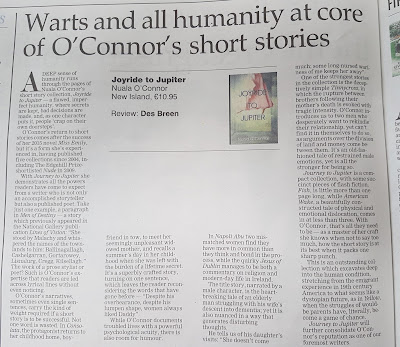
BEAUTIFUL REVIEW OF JOYRIDE TO JUPITER
Des Breen has written a beautiful review of Joyride to Jupiter for the Irish Examiner. Truly delighted with it.

Monday, 14 August 2017
TERRYGLASS ARTS FEST READING
I'm at TerryglassArts Festival on Friday 18th August, reading from #JoyridetoJupiter, 6pm, Riverrun. Free event!
Monday, 7 August 2017
FARMLEIGH EVENT - Domestic Frictions
This Thursday I'm at Farmleigh doing an event with writer-in-res Mia Gallagher and her other guests John Boyne, Sean Millar and Maeve McCarthy. 8pm kick-off with words, music, art and chat.
I'm thrilled to perform at Farmleigh - my Granda, Joseph Murray, lived there as a child with his family (his mother was a cook/housekeeper; his father collected rents). And my maternal Granda, Hugh O'Connor, worked there as a coachman - he took care of the horses among other duties; he had a key to the Silver Bridge, so he could feed the horses on a Sunday. We could see the Victorian Clock Tower on the Farmeleigh Estate from my childhood home across the River Liffey (my parents still live there) - it's one of those landmarks that just says 'home'.
Here's the blurb about the event from the Farmleigh site:
The Home and Family in Words, Song and Images
The Ballroom, 8pm Thursday August 10th
Join 2017 Farmleigh Writer-in-Residence Mia Gallagher for a unique event – an evening of song, words and images which will celebrate and expose the intimate yet often strangely troubled realm of family, home and domestic life. The event will feature some of Ireland’s best loved writers and artists, including the marvellous John Boyne (author of the international bestseller The Boy in the Striped Pyjamas), renowned novelist and poet Nuala O’Connor (author of the International DUBLIN-longlisted Miss Emily), singer-songwriter extraordinaire Sean Millar and award-winning visual artist Maeve McCarthy.
Prepare to be provoked, entertained and inspired as these wonderful artists share their work, insights and observations. The first part of the evening will feature readings, music and film. This will be followed by a lively discussion with all the artists, moderated by Mia.
To apply for FREE tickets to this event email farmleighinfo@opw.ie before 5pm Wednesday 9th August.
Winners will receive 2 free tickets. Please note that only winners will be notified.
For further information on this event contact 01 815 5914
Wednesday, 2 August 2017
INTERVIEW - LEANNE RADOJKOVICH & RACHEL J. FENTON

I am delighted to welcome two New Zealand based writers to the blog today, Leanne Radojkovich and Rachel J Fenton, who is also a visual artist. Leanne's début short story collection First fox, illustrated by Rachel, is just out from The Emma Press, a really exciting English publisher producing beautiful books.
The Cuckoo Review says this 'collection of unusual, fairy-tale like stories… brilliantly enchants and enthralls the reader… First fox [is] unique. With its oddly complex realities mixed with bizarre yet magical moments… The power of these stories… resonated with me long after reading.'
The title story is my new favourite flash and I can't wait to give it a close-reading with students soon. Listen to Leanne read 'First fox' on YouTube here. And you can buy First fox here.
 |
| Leanne Radojkovich |
Leanne Radojkovich lives in Auckland and her flash
fiction street art has popped up all around the
world from USA to France and Tanzania, as well as in New Zealand. Her stories have appeared in many journals and been placed
in numerous competitions.
 |
| Rachel J Fenton |
Rachel J Fenton writes poetry, graphic poetry and
short stories. Her work is published widely. Her
unpublished novel Some Things the English was runner-up in the Dundee
International Book Prize and shortlisted for the Cinnamon Press debut novel
prize. As Rae Joyce, she co-edited Three Words, an Anthology of Aotearoa Womens
Comics.
I began my interview with these two fine, creative women with a few questions to Leanne first, then to Rachel, then some to both.
Nuala: Leanne, talking cats, a woman kept prisoner, birds
appearing from walls. There are echoes of fairytales and, therefore, Angela
Carter in the stories. Would you count her as an influence? Fairy and folktales
in general?
Leanne: I love
folk and fairy tales’ matter of fact bare-bones style, and how in these tales
the everyday and the otherworldly exist in the same dimension. Juxtaposing
fantastic and ordinary elements in a story can feel more truthful, somehow, and
bring to light a new way of looking at a situation. However, much as I admire
Angela Carter’s stories I don’t think of her as a direct influence. I’d count Grace
Paley as number one in that regard; the pared-back brevity of her stories, their
frank tone and sharp sense of humour.
N: The stories are awash with references to
plants (paw paw, frangipani, banana leaves), birds (cockatiels, crows,
roosters) and other animals (cicadas, fox, cat). Is the natural world a go-to
place for you as a writer?
L: The
natural world is what I enjoy most on my daily rounds – anything growing,
flying, running about; perhaps this is
why so many creatures and plants seep into my stories.
N: Children and adults often clash in your
stories, with startling consequences. Is this a theme you consciously explore?
L: I
chose stories for First fox that
seemed to spark off one another - and then saw a theme emerge in some of these
regarding children and adults. I hadn’t consciously considered it before, but
it’s definitely present in this collection.
N: You have been using new ways to get flash fiction
to diverse audiences, such as via YouTube and graffiti. Can you tell me about
that?
L: I’ve shared filmed stories on YouTube and SlideShare. SlideShare is my favouritebecause the viewer clicks through the images at their own pace and the story unfolds like a book of captioned photographs. I’ve posted about a dozen YouTube videos, too. I think of them as a kind of audio/visual chapbook, they’re all filmed using the same three constraints: one continuous shot, from behind, as I walk in bare feet along a beach or a road or the bush - unless it’s freezing, then I wear shoes.Perhaps the most fun has come from posting my street art PinUps. I place one of my nature photos in a $1 frame, paste a story on the back and add a tag saying Please take me home, I’ll look good on your wall. Then I Blu-Tack the frame to stairwells, shop windows, public toilets, park benches. Several strangers have contacted me to say they’ve taken a PinUp on further travels. My favourite came from an American who picked one up in Auckland and took it home where it hangs in his lounge “in the hope,” he wrote, “that someday it will disappear from our wall, one dinner-party evening, to look good on another wall and carry the story into another imagination.” PinUps have popped up in lots of countries from USA to China, Sweden and Indonesia, thanks to wonderful friends and family who wish to be part of the experiment.Nuala: Rachel, you’re a writer and visual artist. Can you talk about the process of illustrating work that is not your own?Rachel: Illustrating other people’s work is something I’ve shied away from on-the-whole, partly I think because of not wanting the responsibility. With Leanne’s work, it was different: I knew and loved her stories, she’s an amazing talent, and I knew her personally – the NZ lit scene is super small – so I felt like I had a good handle on her vision for First fox and I felt I could deliver an interpretation that could fulfil Leanne’s and The Emma Press’s expectations but also satisfy my own creative vision for a cohesive body (albeit it small body) of art.My brief from The Emma Press read along the lines of Six black and white illustrations, some full, some partial, and one cover illustration – details yet to be finalised.The practical process was a case of closely and intensively reading the stories and jotting or sketching the strongest imagery from them, the moments that felt key without acting as spoilers. I had a choice of two or three strong concepts for each story and I picked out my favourite, worked it up in pencil then my own mix of black and sepia water-based ink, scanned it and converted it to black and white and sent it to Emma, founder of The Emma Press.N: How did this collaboration come about?R: I’ve been posting work-in-progress on Instagram, @redhousemary, from the graphic biography that I’m working on, and Leanne was really drawn to one image of Charlotte Brontë walking arm-in-arm with Ellen Nussey – there are few positive depictions of women’s friendships, I feel, and so this perhaps resonated with Leanne and some of the themes in First fox. Leanne had sent a link to this image to The Emma Press and Emma contacted me to invite me to pitch for the job.As a fan of all things blue, I was immediately drawn to the beautiful cover. You’re no doubt happy with the design, look and feel of the book. Can you talk about that?I’m chuffed to bits with the book, from the generous layout to the attention to detail; everything about it speaks of quality and care.Emma had a clear idea of what she wanted for the cover, in keeping with The Emma Press brand: the press’s pamphlets are distinctly recognisable and it was important that the cover of First fox be obviously part of The Emma Press stable. I had been given carte blanche for the interior illustrations, beside their having to be black and white, but the brief for the cover was very specific. Essentially, I had to leave space for the text that, along with the typesetting, was done by The Emma Press. But when it came to the image itself, Leanne felt so strongly drawn to one of the illustrations intended for the interior that it became the cover and what should have been the cover illustration went inside. I work in brown ink, so Emma changed the colour to the specific shade of indigo she had in mind. From the start, Emma communicated so well her clarity of vision for Leanne’s book that I had complete trust in her. It was really a dream job.N: How do you blend your practices (art vs writing). Is it hard to have enough time for both?R: I don’t see it as art v writing; it’s all art. Words are fast for me to put down but take effort from the reader to decode. Visual art is a vastly slower practice but I think it can be decoded easier – humans communicated with images before written language, so maybe it accesses a more primal part of the brain? I feel visual art is a necessary part of my language tool box, though I haven’t always had the home circumstances for it. Until recently my practices had a preferred order of works within a day. For eg, poetry on waking, revising, new writing, editing in the evening, drawing or painting and poetry. But the graphic biography requires up to twelve hours drawing per day, interspersed with research and writing – deadline looming – so I’m missing story and poetry writing, and when I finish this biography I’ll throw myself at them. There’s never enough time. My working-class background has never accommodated my artistic ambitions. Add motherhood and you’re left aching for a room of one’s own. Constraints can be more productive than opportunities, luckily.

N: You both write short stories and flash.
There is a lot of debate (and some disgruntlement) about the definition of
flash fiction. Do you have a favourite definition, or a personal way of
defining flash that makes sense to you?
L: For
me, short stories are are built up in layers; whilst flash fiction relies more
on gaps. This is what attracts me to flash - how small the stories seem, yet
what vast spaces they can conjure for the imagination to roam in. With short
stories it’s almost the reverse, instead of this outward roaming I feel more
more absorbed into the story as I sink into the layers.
R: I think definitions can be limiting more than helpful, and worse, sometimes cliquey. It’s the nature of the categorising endeavour: as soon as you put something into a box, something else is pushed outside it. I write stories, they take whatever shapes and forms best suited to their telling. I don’t want to get caught up in semantics.
N: First Fox is published by The Emma Press. You both live in New Zealand. What made you choose a small English publisher for this book?
L: I’d
long been a fan of Emma Press’s poetry pamphlets, how fresh and vibrant they
are, how beautifully produced. When their poetry pamphlet “Oils” by Stephen
Sexton arrived in the mail, I stared at it for ages almost bewitched. This was exactly
how I’d dreamed of having my stories published one day – in a slim volume with a
stunning cover, and lovely card and paper. A while later, Emma decided to publish
prose and invited submissions. I sent in a m/s of First fox and was stunned to have it accepted, alongside a m/s by
Jan Carson called Postcard Stories.
Some time after, Emma thought it would be lovely to have her first prose
collections illustrated. She considered several artists for First fox and I was stoked when she
commissioned Rae - not only a fabulous artist, but one who knows this country’s
landscapes, trees and plants that feature in most of the stories. Then a final
magic touch, Emma coincidentally chose a similar rich blue for the cover that
she’d used for “Oils.”.
R: See next Q.
N: How healthy is the New Zealand small press
scene?
L: There
are quite a few small presses in NZ producing beautiful work such as these two
recent poetry collections which I treasure: Elizabeth Morton’s Wolf published by Mākaro Press; and Anahera Gildea’s Poroporaki from Seraph Press.
R: There are numerous university presses that give priority to writers within their institutions or specific regions, then there’s a smattering of niche publishers. I think the nature of these can be determined by the fact that indigenous and Pasifika writers turn to publishers that necessarily publish only works by indigenous and Pasifika writers.
N: Which short fiction writers make you think,
‘Yes!’?
L: Grace
Paley, Lucia Berlin, Katherine Mansfield.
R: Tina Makereti, Zadie Smith, Frances Gapper, Trisha Hanifin, Colin Barrett, Katherine Mansfield, David Constantine, Zoe Meager, Raymond Carver, Lydia Davis, and you!
N: What is your writing/creating process – morning or
night; longhand or laptop?
L: I’m happiest writing very early in the morning when
the birds outside are up and busy. My stories begin as stray words and phrases
scribbled on scraps of paper. When enough scraps have accumulated, I spread
them out on the floor and cobble them into some kind of order. Then I start
typing.
R: I like to get a story down in one go, so mid/late morning, laptop.
N: What
story or flash do you love? (You know the one that begs to be re-read over and
over.)
L: These past few months I’ve been returning to “The Geography of a Name”
by Frankie McMillan (in My Mother and the Hungarians) and Zoë Meager’s “Sharp Stars” (in To Carry Her Home). Both
stories concern migrants. They evoke - with the lightest touch possible - losses
their characters sustain as they are forced, one way or another, into new
lives.
R: I go back to Mansfield’s “The Doll’s House”, Davis’ “Break It Down”, Constantine’s “Tea at the Midland”, Thisbe Nissen’s “Deer at Rest”, that I first saw mentioned in an interview you gave to Flash Frontier, I think.
N: Is
there any writing advice you received that stays with you always? What
one piece of advice would you offer novice writers?
L: When I’m stuck I re-read Grace Paley’s story “A Conversation with my
Father” in which the narrator and her father argue about the purpose of short
stories, and how to write them. I’ve also learned a great deal from several Fish
Writing Courses run by Mary-Jane Holmes.
R: Paraphrasing here: 'Everything’s been written by someone but not by you' – from Nuala Ní Chonchúir. Detail what you alone can.
N: What
are you working on now/what can we expect next?
L: The
scraps box is filling…. more short stories are on the way.
R: I’m on the home straight of a graphic biography of Mary Taylor, Charlotte Brontë’s bestie, that I got CNZ arts funding for. I’ve a couple of short story collections and a poetry collection out on submission and I’m looking for a home for two novels. I’ve another novel outline waiting in the wings as well as poetry and stories to write.
Thank you, Leanne and Rachel, for a wonderful interview. I hope the book does really well for you both. Readers you can buy First fox here.
Subscribe to:
Posts (Atom)